Worm Study Identifies a Neural Circuit for Selective Odor Memory Forgetting
In C. elegans, a peptide and two-neuron relay helped erase one learned odor while preserving another. The findings are early evidence from a simple animal model.
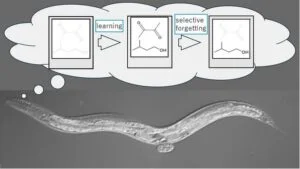
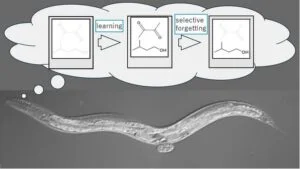
A small worm can forget one learned smell while retaining another, and researchers have traced that selectivity to a defined molecular pathway. The finding offers a closer look at active forgetting, but it comes from experiments in Caenorhabditis elegans, not people. It does not show how human memories are erased or suggest a treatment for memory disorders.
The Kyushu University team studied how the worm’s nervous system handles memories of attractive odors. In earlier work, the researchers had found that AWA sensory neurons hold an odor memory and that signals from AWC neurons can prompt its removal. The new study, led by PhD candidate Yuuki Onishi with senior author Professor Takeshi Ishihara, identifies molecules and an intervening neuron involved in that process. The paper appeared in Current Biology.
A three-neuron route to forgetting
The pathway begins with AWC neurons releasing a neuropeptide called NLP-47. That peptide binds to the GNRR-1 receptor on AIZ interneurons, which sit between AWC and AWA in the circuit. AIZ neurons then release glutamate. The glutamate acts on the GLR-4 receptor on AWA neurons, where the odor memory is stored, and helps trigger its erasure.
The researchers describe this as a neuropeptide-to-glutamate relay: NLP-47 carries the signal from AWC to AIZ, and glutamate carries it onward to AWA. When the team used optogenetics to suppress AWC and AIZ activity, the worms became more resistant to forgetting. Worms in which NLP-47, GNRR-1 or glutamate signaling did not function also retained odor memories more readily. Together, these experiments support a role for the pathway in active forgetting.
The work builds on a 2013 study from Ishihara’s group, which had mapped the relevant neurons but not identified the molecules that carried the forgetting signal. Because C. elegans has 302 identified neurons, researchers can trace activity through its nervous system with unusual precision. The worm is blind but responds strongly to odors, making it useful for studying olfactory learning in a relatively simple circuit.
One odor faded while another remained
To test forgetting, the team trained worms to associate the smell of diacetyl with an experience, then assessed their response about four hours later. The researchers used movement toward the odor as an indication that the worms had forgotten the learned association; a reduced attraction indicated that the memory remained. This timing reflects the period in which the worms typically lose the odor memory under the study conditions.
The key test involved training the animals on two odors at once: diacetyl and isoamyl alcohol. Four hours later, the pathway was associated with loss of the diacetyl memory while the isoamyl alcohol memory remained. That result suggests the circuit can affect memories selectively rather than weakening every odor memory at the same time. It is a specific result in one learning task, though; the study does not establish how the worm distinguishes between memories or whether the same selectivity applies to other kinds of learning.
The authors frame selective forgetting as useful for adapting to changing surroundings: an animal may need to discard an experience that no longer matters while keeping other learned information. Memory research has often focused on how memories form and persist, Ishihara said, while the mechanisms that remove particular memories have received less attention.
What the finding may mean for human research
The study points to a possible research direction, not a direct explanation for human memory loss. GNRR-1 is an evolutionary relative of the human gonadotropin-releasing hormone receptor, and related receptors have been found in the hippocampus of rodents, a brain region involved in memory. Their role in memory there remains unknown. The worm findings therefore raise a question for further study: do mammals use related signaling steps to regulate the loss of particular memories?
The authors suggest that understanding how selective forgetting works could eventually inform research on conditions involving dysregulated memory, including dementia and post-traumatic stress disorder. But this experiment did not study either condition, and it provides no evidence that changing this pathway would prevent or treat them. A molecular resemblance across species can guide research, but it does not establish that the same circuit or effect operates in people.
For now, the strongest takeaway is that forgetting in this worm can be an organized process: NLP-47, GNRR-1 and glutamate connect identified neurons in a circuit that selectively affected one of two odor memories. The next step is to determine whether comparable pathways exist in more complex animals and how they influence memory there.