Gene Editing Advances Toward Treating More Than One Rare Disease
Base and prime editing are reaching human trials, while early mouse results suggest one approach could address several diseases with the same genetic error.

Gene editing may eventually reach more people if a treatment can address a shared genetic feature across diseases, rather than being designed for one mutation at a time. At the European Society of Gene & Cell Therapy meeting in Hamburg, researcher David Liu described progress toward that goal, alongside advances in base editing and prime editing. The work spans laboratory studies, animal models and early human trials; it has not yet established broad, lasting benefit for patients.

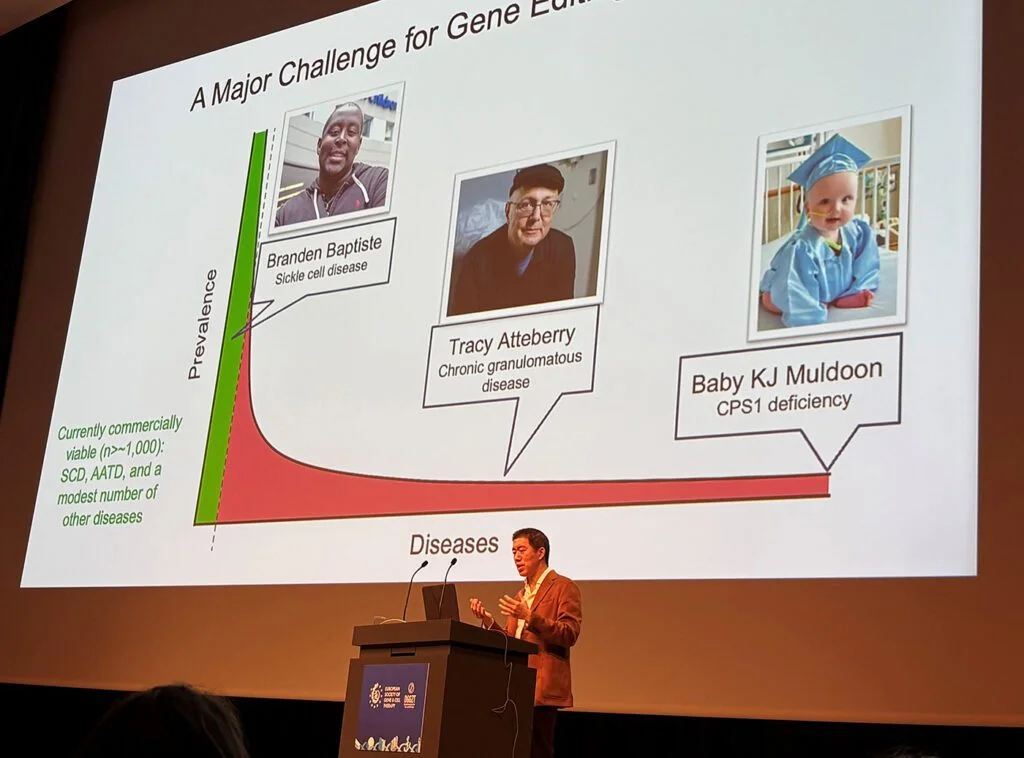
Liu framed the field’s challenge in terms of scale: more than 200,000 known mutations are associated with about 8,000 genetic diseases, which affect roughly 400 million families. Many conditions are individually rare, making it difficult to develop and deliver a separate treatment for each one. In his view, progress will depend on scientific advances working alongside improvements in manufacturing, clinical development and the economics of treatment.
Base editing, first reported by Liu’s group a decade ago, and prime editing, described three years later, build on CRISPR-Cas technology. Both can make targeted changes to DNA, including single-letter substitutions. Liu co-founded Beam Therapeutics and Prime Medicine, companies developing these approaches.
AI tools refine prime editing
Two recent projects from Liu’s lab apply artificial intelligence and machine learning to practical hurdles in prime editing. One, published in Nature Biotechnology, used ProteinMPNN to improve prime editor proteins. Earlier, the lab had used phage-assisted continuous evolution to produce PE6 editors with greater activity. Those versions, however, tended to have lower stability and expression.
ProteinMPNN generates protein sequences predicted to fold into a specified structure. The researchers used it to redesign as much as 25 percent of the amino acids in the editor’s reverse transcriptase, aiming to address the stability problems. The resulting PE8 variants showed higher expression and editing efficiency across different cell types. These are laboratory findings; the report does not establish how the variants will perform as treatments in people.
A separate paper introduced OptiPrime, a free machine learning tool for predicting prime editing outcomes. Each prime editing guide RNA, or pegRNA, has several variable regions that can affect how efficiently an edit is made. Because many pegRNA designs may be able to produce the same edit, choosing among candidates can take time. OptiPrime ranks possible designs, and researchers can use the OptiPri.me website to generate a list for further work.
From animal studies to early clinical work
Liu cited nine examples in which precision genome editing improved disease features in animal models, spanning conditions such as progeria, sickle cell disease, cystic fibrosis, phenylketonuria and spinal muscular atrophy. He estimated that this body of work represented about a century of research effort. Animal results can show that an approach merits further study, but they cannot establish that it will be safe or effective in people.
Some programs have advanced into clinical development. In March 2025, Beam Therapeutics reported the first clinical correction of a disease-causing mutation in a person, in a study of BEAM-302 for alpha-1 antitrypsin deficiency. Around the same period, a personalized base editing treatment for an infant known as Baby KJ drew attention to the possibility of tailoring an edit to a specific mutation.
Prime editing has also reached early human trials. In April 2025, 57-year-old Tracy Atteberry received stem cells edited outside her body to repair a two-base deletion. The treatment was reported later that year by Jennifer Gori and colleagues. In October, the first participant entered an in-body prime editing trial for Wilson disease, known as PM577a. These early milestones show that the techniques are being tested clinically, but they do not yet answer how well they work across patients or how durable their effects may be.
Liu pointed to a more accommodating environment for starting studies and developing treatments, and noted that draft guidance on individualized genome editing products had appeared the day before his talk. Clinical progress will still depend on evidence about safety, manufacturing and benefit for each approach.
A possible shared approach to stop-codon mutations
Liu’s group is also exploring whether one treatment could help with multiple diseases caused by premature stop codons. These DNA changes can make cells stop producing a protein too early. Around 30 percent of genetic diseases include at least one such codon. A suppressor transfer RNA, or tRNA, can recognize the stop signal and allow production of a full-length protein to continue.
The proposed method, called prime editing-mediated readthrough of premature termination codons (PERT), aims to convert a tRNA that the body can do without into a suppressor tRNA. The human genome has 418 tRNA genes, while 61 triplets encode amino acids. Liu’s team reasoned that this redundancy could leave room to alter one tRNA without disrupting normal protein production.
Led by postdoctoral researcher Sarah Pierce, the lab used prime editing to change each of the 418 tRNAs so it could recognize one of three stop codons: CUA, UCA or UUA. The team then focused on a leucine tRNA that showed the strongest suppression activity and developed an optimized version.
In a mouse model of Hurler syndrome, PERT led to production of about 7 percent of normal enzyme activity. Liu said this level might be enough to improve disease features, but the finding is preliminary and comes from an animal study. His group is also investigating whether the approach can work without producing excess suppressor tRNA: the reported design replaces about 40 percent of the tRNA that was changed.
The broader test for gene editing will be whether these advances can reach people with conditions too rare to attract conventional development. A collaboration involving the Broad Institute, Boston Children’s Hospital and The Jackson Laboratory has established the nonprofit Center for Therapeutic Genetics to connect people with rare diseases to research efforts. Apertura, Viralgen, Beam Therapeutics and Prime Medicine provided initial commercial support.
For families, the developments offer reasons to follow the research while keeping expectations measured. Animal studies, tool improvements and first-in-human milestones mark progress, but they are early steps. The key question is whether future studies can show safe, durable benefits and make treatments practical for more than a small number of patients.