Supplement Claims, Study Spin and Gaps in Product Checks
Research found widespread hype in supplement industry statements, while product checks can miss undeclared ingredients. Here’s what consumers should know.

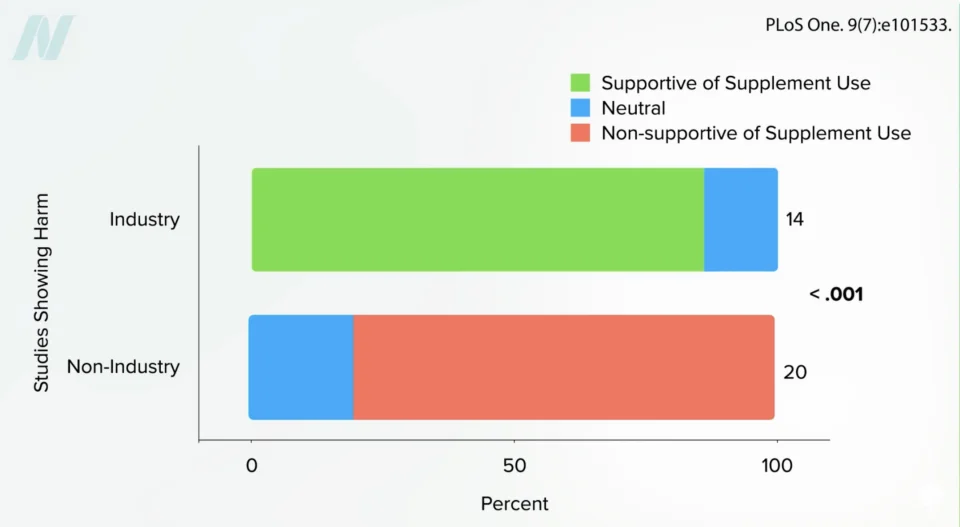
Supplement marketing can stay upbeat even when research finds no benefit or raises safety concerns. A review of statements from supplement industry trade groups found that all included some form of “spin”—language that hypes or downplays clinical findings. More than 90% of studies reporting no benefit or possible harm were followed by statements that still supported using supplements. That pattern makes it harder for consumers to judge what the evidence says.
The findings concern how industry groups described research; they don’t establish that every supplement is ineffective or unsafe. But they do show why a confident claim in promotional material shouldn’t be treated as a reliable summary of a study. The review’s authors warned that these statements may help sustain supplement use even as evidence accumulates of limited benefit and, for some products, potential harm. The figures are shown in the Supplementation Regulation and Side Effects: Efforts to Suppress the Truth video.
Research may not change users’ minds
In a separate study, most dietary supplement users said independent research contradicting manufacturers’ efficacy claims would have little influence on them. Only about one in four said they would stop taking a product if public health authorities described it as a waste of money. These responses measure what participants said they might do; they don’t show how people would act in every real-world situation. Still, they suggest that correcting a claim with research alone may not be enough to change a person’s view.
That matters because supplement decisions can involve more than whether a product works. Consumers may not know exactly what a product contains, and some ingredients can interact with medicines or affect health conditions. Anyone weighing a supplement alongside prescribed treatment can discuss the product and its label with a doctor or pharmacist, who can help assess possible interactions and whether the evidence supports its intended use.
Rules exist, but checking products is difficult
The source article compares today’s supplement market with the historical story behind the phrase “snake oil.” Clark “the Rattlesnake King” Stanley sold a product that was found in 1916 to contain no snake oil; it was described as a mixture of moth repellent and turpentine. The account says he was fined $20 under the Pure Food and Drug Act. The comparison is striking, but the practical issue today is more specific: the sheer number of products makes routine checks difficult.
The U.S. Food and Drug Administration has estimated that more than 85,000 dietary supplement products are available in the United States. Laws apply to the industry, but researchers have described obstacles to oversight, including the number of products, underreporting of adverse effects, challenges in pursuing violations, and the ability to rebrand products that have been removed from sale. The article cites an estimate of 23,000 emergency room visits each year associated with dietary supplements. That figure is an estimate, and it does not tell us the risk from any one product or ingredient.
Research has also found undeclared pharmaceutical ingredients in some supplements, particularly products marketed for erectile dysfunction, weight loss, diabetes, and high blood pressure. An ingredient that isn’t listed on the label could expose a consumer to unexpected effects or interactions. Independent quality certification may offer some information about a product, but it doesn’t guarantee every claim or eliminate all risk. Researchers have reported “dry labbing,” in which quality assurance documents are approved without the testing they are supposed to reflect.
A stimulant study and a costly legal fight
One case involved β-methylphenylethylamine, or BMPEA, a stimulant with similarities to amphetamines. A Harvard researcher published work replicating earlier findings that detected BMPEA in certain supplements sold in the United States. The article identifies Hi-Tech Pharmaceuticals, maker of the weight-loss products Black Widow and Yellow Scorpion, as one company involved in the dispute that followed.
The company sued the researcher, alleging libel, slander, and product disparagement, and initially sought $200 million in damages. A STAT report documented the case and quoted the company’s head saying he hoped to “silence this guy.” The suit ultimately failed, but the researchers cited in the source said the lengthy, costly case could discourage other academics from investigating supplements. A lawsuit itself doesn’t determine whether a product is safe or whether a study is correct; those questions depend on the evidence.
For consumers, the clearest takeaway is to treat a supplement’s advertised benefits as claims to evaluate, not as proof of effectiveness or purity. Study design, the size and limits of the research, and the exact product tested all matter. Research findings about one formulation may not apply to another. If a label leaves questions about ingredients or intended use, a doctor or pharmacist can help put the claim in context.
For more background, see Spin Doctors: How the Media Reports on Medicine, Dietary Supplement Snake Oil, Heavy Metals in Protein Powder Supplements, Some Dietary Supplements May Be More Than a Waste of Money, Black Raspberry Supplements Put to the Test, and Dangers of Dietary Supplement Deregulation. The source also recommends STAT for medical reporting.