Yoga and Health: What Clinical Studies Show About Benefits and Risks
Trials suggest yoga may help neck pain and some physical measures, but benefits vary by condition and injury risks call for care.
Yoga’s health effects depend on what it’s being compared with. Across clinical studies, it appears to help some people with chronic neck pain and may improve certain measures of strength and flexibility. For several other concerns, benefits look similar to those of ordinary exercise, while evidence for some claims remains uncertain.
A 2016 survey estimated that 36 million Americans practiced yoga to some degree. Observational studies have linked yoga participation with better health and lower obesity rates, but those findings can’t show that yoga caused the differences. People who are already healthier may be more likely to practice. Yoga users may also report more health conditions because people experiencing symptoms seek out the practice. Controlled trials offer a clearer, though still condition-specific, picture.
Mental health findings are mixed
Research reviewed in the source article found no clear benefit for depression compared with doing nothing. Yoga appeared to ease anxiety in some studies, but not among people with diagnosed anxiety disorders. When researchers compared yoga with other forms of exercise, its apparent anxiety benefit disappeared, suggesting that physical activity may explain the improvement.
Among older adults, yoga appeared to reduce depression more than other exercise in the studies discussed. It did not show the same advantage for anxiety or for people’s broader sense of mental health. These findings don’t support treating yoga as a substitute for care for mood or anxiety disorders.
Some physical benefits stand out
Chronic nonspecific neck pain is one area where yoga looked promising. A review of 10 randomized controlled trials found greater improvement with yoga than with control groups, including groups doing other exercises. The review authors concluded tentatively that yoga may reduce pain intensity and related disability, while improving neck movement, quality of life, and mood. The results support yoga as a possible option to discuss for neck pain, though they don’t establish that it will help every person.
For people with type 2 diabetes, studies comparing yoga with exercise found improvements in both short-term and longer-term blood sugar measures in the yoga groups. The comparison was imperfect: nearly half the studies didn’t define and follow a well-planned exercise program for the control group, and only three of the eight used an exercise program with intensity comparable to yoga. Six studies were conducted in India. These limitations make it harder to tell how much of the difference came from yoga itself.
For irritable bowel syndrome, randomized trials found yoga performed better than drug treatment and about as well as moderate-intensity walking. The source article doesn’t provide details on the number of trials or the size of the effects, so the finding should be read as a general signal rather than a precise estimate.
Strength, mobility, and bone evidence
Compared with other exercise, yoga appeared to improve lower-limb strength and lower-body flexibility more. Balance, mobility, and walking speed were broadly similar between yoga and other activities.
A study designed to assess bone density used a 12-minute DVD featuring 12 poses intended to stimulate bone growth in the spine and hips. Results suggested a benefit for spinal bone density, but not at the hip. However, only a few dozen of the 741 people recruited submitted the requested bone scans—about 5% of the original group. Because people with favorable results may have been more likely to send in scans, the results aren’t convincing evidence that yoga strengthens bone.
Findings in women’s health
For insomnia, yoga did better than no intervention but not than controls that involved physical activity. In studies of people with cancer, mostly breast cancer, walking improved sleep more than yoga. Among breast cancer survivors, six months of yoga had effects on inflammation markers similar to six months of other exercise. Findings for cancer-related fatigue and quality of life followed the same pattern: yoga was better than doing nothing, but not better than other physical activity. The reviewed evidence also didn’t show that yoga helped breast cancer-related lymphedema, a buildup of fluid in tissue.
Urinary incontinence involves different symptoms. Urgency incontinence means urine leaks with a sudden, strong need to urinate; stress incontinence involves leaks triggered by activities such as sneezing. After three months, yoga didn’t significantly improve incontinence overall or urgency symptoms. Stress incontinence fell by an average of 61% in the yoga group, compared with 35% in controls. That difference suggests a possible benefit for stress incontinence, but the findings don’t establish that yoga will help an individual.
Injury risk and safer practice
A systematic review of nine observational studies included more than 9,000 yoga practitioners and more than 9,000 people who didn’t practice yoga, from the United States, Europe, Asia, and Australia. Many yoga practitioners reported an injury or another adverse event, but most events were mild and temporary. Overall risk was comparable to that among non-practitioners. The estimated rate of yoga-related injuries was 1.45 per 1,000 hours of practice. For comparison, the source gives rates of about 2.5 for running, 3.7 for soccer, and 5 for tennis per 1,000 hours; it describes skiing as having more than five times yoga’s injury rate.

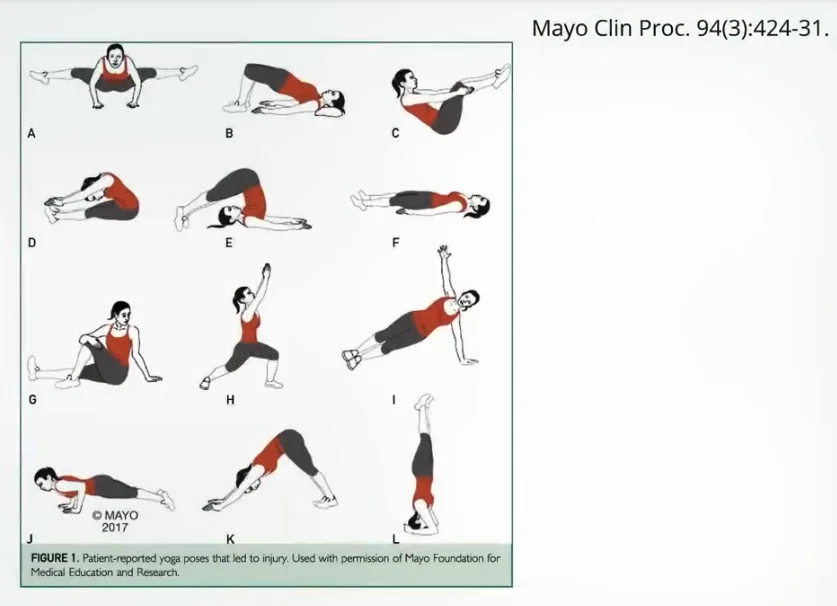
Yoga still carries a risk of injury, particularly when poses place intense demands on the body. Headstand, shoulder stand, lotus and half-lotus, deep forward or backward bends, and handstand are among the poses identified as higher risk. The spine is a common site of injury. A qualified instructor can help adapt practice, especially for beginners. People with existing health conditions can ask their clinician and instructor about modifications; for example, people with glaucoma may need to avoid inverted poses, and those with fragile bones may need to avoid forceful movements. The evidence points to yoga as one possible form of physical activity, with benefits that vary by condition and a need to match the practice to the person.