Caffeine and Parkinson’s Symptoms: Short-Term Trial Benefit Did Not Last
A six-week trial found temporary symptom improvement with caffeine, but a longer study found no sustained benefit over placebo.
Caffeine showed a short-term signal for easing Parkinson’s symptoms in one clinical trial, but a later, longer study did not find lasting benefit. That difference matters: observational research has linked coffee drinking with Parkinson’s risk and outcomes, but those associations can’t establish that caffeine treats symptoms. The available trial results don’t support relying on caffeine as a long-term symptom therapy.
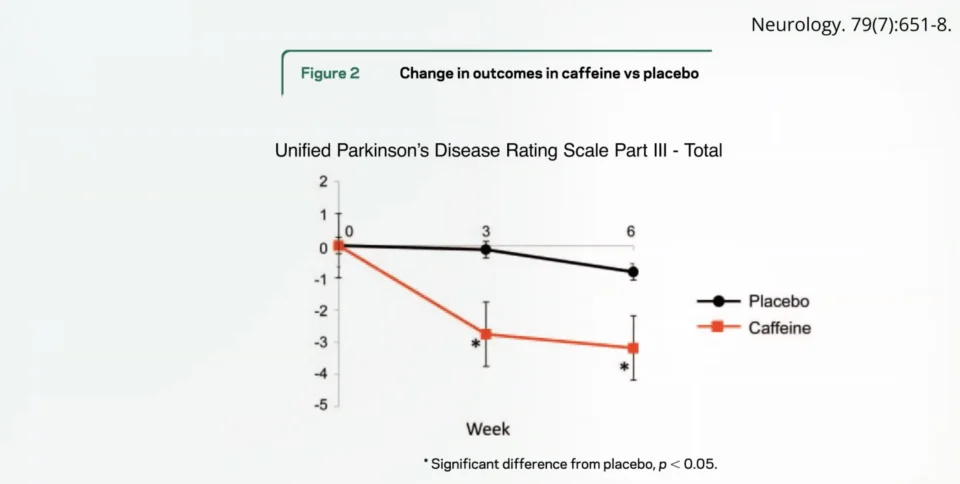
What the short trial found
A randomized, double-blind, placebo-controlled study tested caffeine in people with Parkinson’s disease over six weeks. Participants assigned to caffeine began with an amount roughly equivalent to one cup of coffee twice daily, taken in the morning and after lunch. The amount was then increased to about two cups’ worth twice daily. The source describes that later amount as comparable to four cups of black tea or six cups of green tea, twice a day.
Compared with placebo, the caffeine group had a significant improvement in symptoms within three weeks. That is a potentially useful early signal, but it came from a short study. The article does not give the number of participants or the size of the measured improvement, so readers can’t judge those details from this account alone. A result described as significant also doesn’t, by itself, tell us how noticeable or meaningful the change was in daily life.
The study was designed to test caffeine as a treatment, which gives it more direct relevance to symptom relief than research that simply tracks coffee habits. Random assignment and blinding can help limit some sources of bias. Still, a six-week result cannot establish whether a benefit continues with longer use, or whether caffeine affects the underlying progression of Parkinson’s disease.
The longer follow-up changed the picture
Five years later, a separate randomized study tested caffeine for more than six months. Participants received about two cups of coffee’s worth twice daily. This time, caffeine did not improve symptoms over placebo. Taken together, the studies suggest that any symptom effect seen early may not persist. They do not establish why the findings differed, and the short trial alone shouldn’t be treated as evidence of a durable benefit.
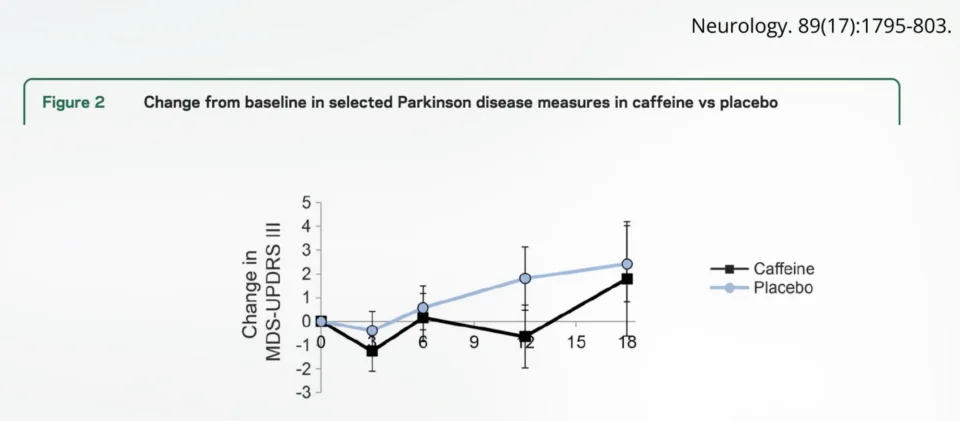
The original article raises tachyphylaxis—the fading of an effect after repeated use—as one possible explanation. That idea may fit the pattern, but the two study results don’t prove that this was the cause. Differences in study length, participants, or other features could also matter; the details provided here aren’t enough to determine which explanation is right.
The longer study is especially relevant to people wondering whether caffeine could be used day after day for symptom control. Its result did not show a sustained advantage over placebo. The source article reports that caffeine therefore cannot be recommended as symptomatic therapy for parkinsonism. People considering changes to caffeine intake can discuss their own circumstances with a doctor or pharmacist, particularly if they have questions about how caffeine fits with their care.
Risk research is a different question
Research on whether coffee drinkers are less likely to develop Parkinson’s disease addresses prevention, not treatment after diagnosis. The source cites observational findings linking coffee or caffeinated tea with lower risk of developing the disease, and another study associating those drinks with a lower risk of premature death among people with Parkinson’s. Such studies can identify patterns, but they can’t show that caffeine caused them. Other differences between people who do and don’t drink coffee may help explain an association.
The same caution applies to broader claims about diet. The source describes research associating predominantly plant-based eating with lower Parkinson’s prevalence and incidence, while also discussing possible protective roles for antioxidants and potential risks associated with some animal-based foods. These are background findings, not evidence that a particular diet can prevent or manage the disease for any one person. A case report about a low animal-fat diet and daily whole grains and strawberries is also limited: an individual report can’t establish that the foods caused symptom changes.
Plant foods aren’t automatically beneficial or harmless in every amount. The source discusses soursop, also called graviola, and concerns about neurotoxic compounds and a possible association between high consumption and atypical Parkinson-like illness. That example reinforces why broad dietary labels don’t answer questions about individual foods. The material provided does not establish a safe or harmful amount for a particular person.
What people with Parkinson’s can take from this
The clearest practical takeaway is that caffeine’s possible short-term effect did not translate into a sustained benefit in the longer trial. Coffee may still be part of someone’s usual diet, but these findings don’t show that increasing intake will control Parkinson’s symptoms or slow disease progression. People should not change prescribed treatment on the basis of coffee research; questions about symptom management or caffeine’s place in their routine are reasonable to raise with their clinician or pharmacist.
More research would need to clarify who, if anyone, might experience a temporary response and whether that response has practical importance. For now, the contrast between a six-week improvement and no benefit over placebo after more than six months is the central finding: early promise is not the same as lasting symptom relief.
Related sources and videos referenced in the original article:
- James Parkinson’s description of the disease
- Dietary factors and Parkinson’s disease
- Plant-based diets, oxidative stress and inflammation
- Soursop and neurotoxicity
- Soursop, blood pressure and uric acid
- Diet case report
- Research on edible plants and Parkinson’s
- Coffee and Parkinson’s risk
- Coffee, tea and premature death
- Six-week caffeine trial
- Longer caffeine trial
- Coffee Put to the Test for Treating Parkinson’s Disease
- Preventing Parkinson’s Disease with Diet
- Treating Parkinson’s Disease with Diet
- Is Something in Tobacco Protective Against Parkinson’s Disease?
- Peppers and Parkinson’s: The Benefits of Smoking Without the Risks?
- Could Lactose Explain the Milk and Parkinson’s Disease Link?
- Parkinson’s Disease and the Uric Acid Sweet Spot
- The Role Meat May Play in Triggering Parkinson’s Disease
- Coffee and Cancer
- Preventing Liver Cancer with Coffee?
- Coffee and Artery Function
- Coffee and Mortality
- Does Coffee Affect Cholesterol?
- Does Adding Milk Block the Benefits of Coffee?
- Which Coffee Is Healthier: Light vs. Dark Roast
- Does Low Acid Coffee Cause Less Acid Reflux?